
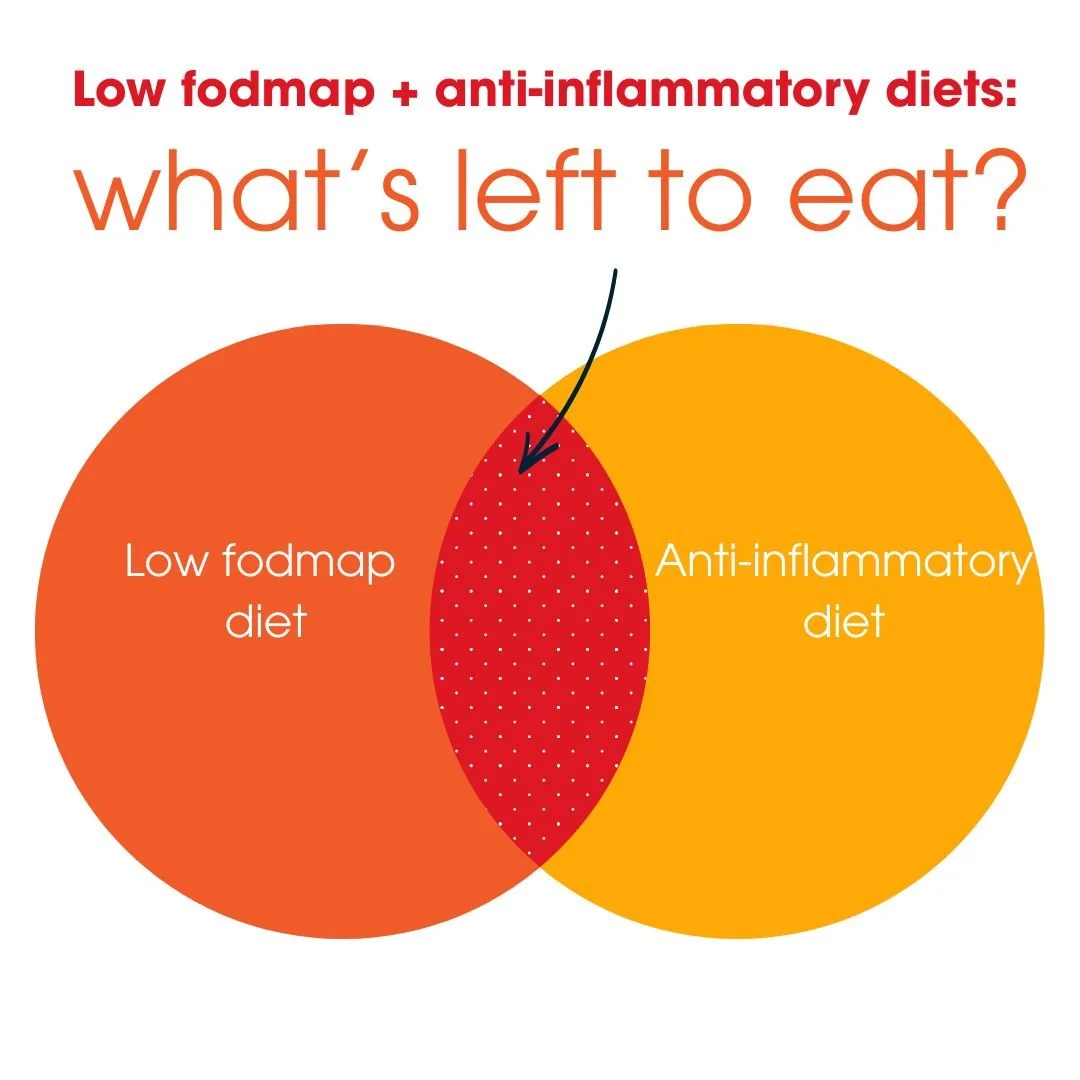
Low fodmap + anti-inflammatory diet: what’s left to eat?
Yes, it’s my birthday. And nothing says “happy birthday” quite like enrolling in an arthritis program – not!
My immediate challenge is mastering GLA:D® Good Life with osteoArthritis: Denmark - an education and exercise program for people with hip and knee osteoarthritis. Then, once I’ve graduated from that, I’ll tackle Onero, an evidence-based exercise program designed to build bone and reduce fracture risk.
Because I’m determined to do everything I can to keep running, keep moving and, hopefully, chase my grandchildren around one day. (They’re still entirely imaginary, but I’m hoping to have plenty of them in a decade or so!)
So, naturally, I started thinking about what else I could do to look after my joints and bones. An anti-inflammatory diet seemed like an obvious place to start.
Except… I already follow a low fodmap diet. And the thought of stacking an anti-inflammatory diet on top of low fodmap is, frankly, horrifying. And overwhelming. And makes me question all my life choices…
If you have IBS, you already know that following low fodmap can sometimes feel like a full-time job. Add osteoarthritis and low bone density to the mix and suddenly the internet seems to have an opinion about everything you should stop eating. No sugar. No dairy. No gluten. No nightshades. No meat. No carbohydrates. And apparently, nothing else you actually enjoy.
But here's the good news: you don't necessarily need another restrictive diet. The low fodmap and anti-inflammatory diets have much more in common than you might think. Rather than creating yet another list of foods I can't eat, I'm looking at how I can make the low fodmap diet I already follow more varied, more nutrient-dense and more supportive of healthy bones and joints. And, importantly doing this without making my life miserable! Here’s what I’ve learned so far.
What is an anti-inflammatory diet?
According to Arthritis Australia, an anti-inflammatory eating pattern is based largely on nutrient-rich whole foods: vegetables, fruit, whole grains, legumes, nuts and seeds, healthy fats and oily fish – aka a Mediterranean-style diet.
Importantly, Arthritis Australia doesn't claim that diet can cure arthritis. Rather, a healthy diet may help with general health, healthy weight management and, for some people, arthritis symptoms.
And here's where things get interesting for people with IBS: many of these foods can still be part of a low fodmap diet. The trick is choosing the portions and varieties that suit your individual tolerance. Monash University stresses that fodmap content is dose-dependent and that the low fodmap diet is designed to move from restriction towards reintroduction and personalisation. With this in mind, here are 5 top tips to keep in mind when blending the low fodmap and anti-inflammatory diets together.
1. Don't add another list of “bad foods”
This may be the most important tip. You don't need to start eliminating foods simply because they appear on an anti-inflammatory “avoid” list. Arthritis Australia specifically notes that there is little evidence that individual foods cause arthritis symptoms and warns against unnecessarily eliminating whole food groups because this can mean missing important nutrients.
Instead, ask: - “What can I add?”
Add a drizzle of extra virgin olive oil. You too might also fall in love with my current favourite – Goldi’s garlic-infused olive oil – delish! Add tolerated vegetables. Add berries or another low fodmap fruit. Add fresh herbs and spices. Add nuts and seeds in appropriate portions. Add oily fish. That's a very different mindset from “What else do I have to give up?”
2. Make omega-3s your friend
Fatty fish such as salmon, sardines, trout and mackerel are rich sources of omega-3 fats and feature prominently in Arthritis Australia's anti-inflammatory eating advice. The great thing is that you don't need a complicated recipe.
Try:
Tuna and quinoa salad
Fish with rice and greens
If you don't eat fish, nuts and seeds can also contribute plant-based omega-3 fats. If you do want to supplement, check the label for EPA + DHA, rather than simply looking at “1,000 mg fish oil”. A typically 1,000 mg fish oil tablet may contain 300mg EPA + DHA, although formulations vary enormously. Talk to your pharmacist about an enteric-coated or odour-controlled product and experiment with taking them at different times of day (but never on an empty stomach). If you find omega-3 supps hard to tolerate, try an algae-derived omega-3 option.
For full transparency, I’m not a sardine, trout or mackerel fan but I have made a conscious decision to eat salmon, ocean-caught fish and/or tuna twice a week. And I have not had great success yet with my omega-3 supplement, yet. If I mis-time it, I get a really upset tummy and fish burps.
3. Put bone health on the plate
If you have low bone density, calcium deserves considerably more attention than another “anti-inflammatory food” list. For Australian women aged 51–70, the calcium RDI is 1,300 mg per day (slightly lower for men in the same age group). Monash University specifically highlights calcium as a nutrient worth watching on a low fodmap diet because people sometimes unnecessarily reduce dairy when avoiding lactose.
The good news is that you don't have to give up dairy.
Try lactose-free milk and yoghurt, firm cheeses such as cheddar, or calcium-fortified plant milks. Monash recommends choosing a fortified milk containing at least 120 mg calcium per 100 mL. Firm tofu can also contribute useful calcium but do have a look at the recipe suggestions from Monash for calcium-rich food inspo.
Think “calcium at several meals”, rather than trying to cram 1,300 mg into one enormous serving. I’ve found this really easy, as I love a morning protein smoothie and have started taking a yoghurt snack pack to work each day.
4. Check your vitamin D. Don't guess!
Vitamin D helps your body absorb calcium and is important for bone and musculoskeletal health. The Australian Nutrient Reference Values give an Adequate Intake of 10 µg vitamin D per day for adults aged 51–70 and 15 µg for people over 70.
But vitamin D is one nutrient where supplementation shouldn't be a case of “more must be better”. Your vitamin D status can be assessed with a blood test, and Healthdirect recommends discussing supplementation with your doctor if your vitamin D is low.
If you do need a supplement, ask your pharmacist or doctor for a simple vitamin D preparation without fodmaps. The vitamin itself isn't a fodmap, but gummy, chewable and powdered products can contain ingredients that don't agree with sensitive guts.
The same principle applies to calcium supplements: food first where possible, supplement when clinically appropriate, and check the complete ingredient list with your pharmacist or dietitian.
After getting my bloodtest results back, I’ve started on Vit D and calcium supplementation with no side effects.
👉🏽 Useful tip: Most calcium & Vit D tablets I’ve found are HUGE. Which is fine, if you don’t have issues with large tablets, but they definitely don’t suit my mum or daughter. I’ve recently found D3 Drops in an oral liquid form (Vic D3 1000 IU per 1 drop) which may be easier for some people to consume.
5. Make your LOW fodmap diet LESS restrictive
This might sound counterintuitive, but it could be the most important step of all. If you've been following a strict low fodmap diet for a long time, ask yourself whether you have completed the reintroduction and personalisation stages.
Monash University recommends that the strict elimination phase lasts only around 2–6 weeks, followed by systematic reintroduction and personalisation. The aim is to discover which fodmaps and quantities you actually tolerate, not to remain unnecessarily restricted forever. That matters for bone health and overall nutrition because greater food variety makes it easier to meet your nutritional needs.
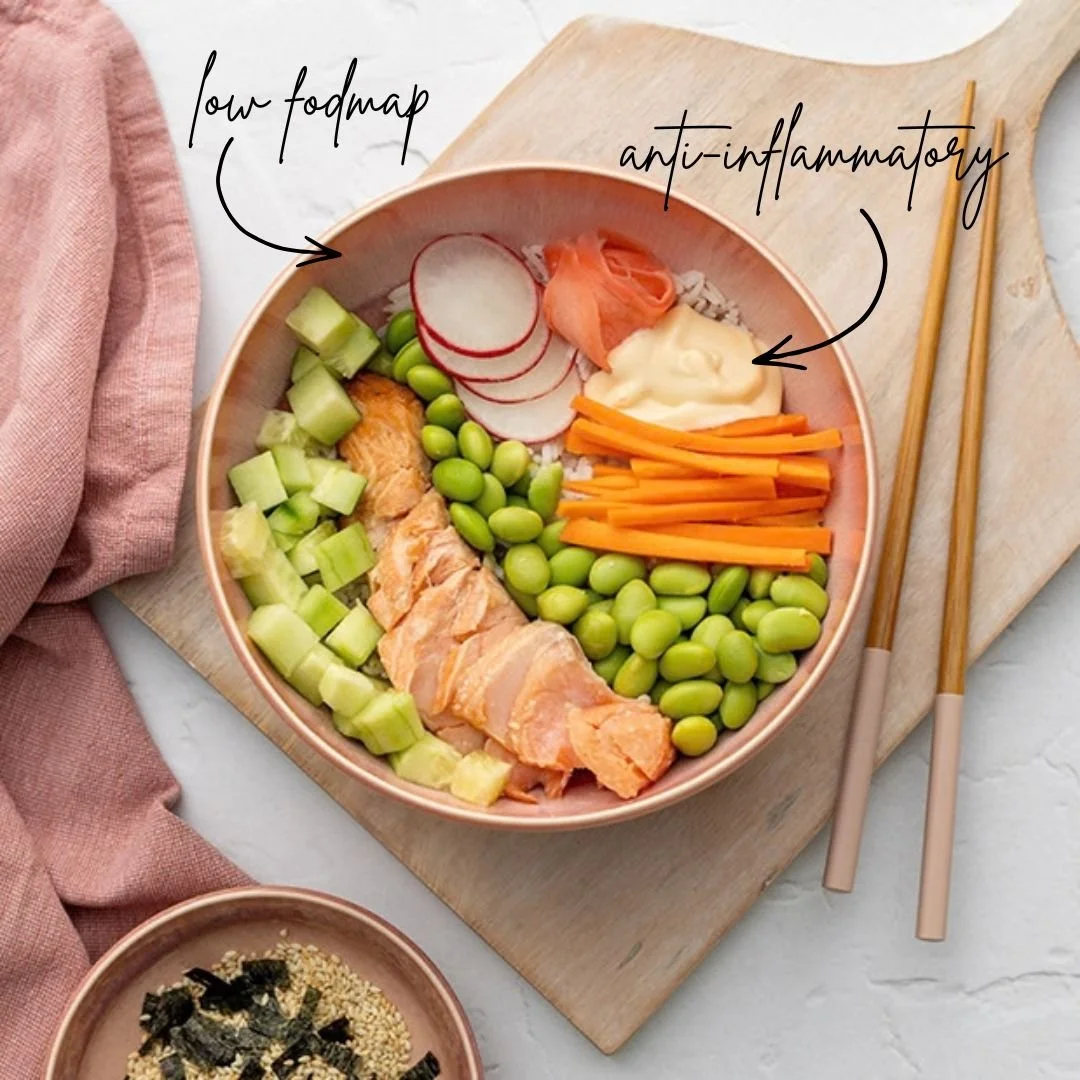
So what can I eat?
So instead of asking: “What else do I need to eliminate?” try asking: “What can I safely add back?” That could be the most anti-inflammatory thing you do for your diet. You don't need a perfect diet If you have IBS, osteoarthritis and low bone density, eating well can feel ridiculously complicated. It doesn't have to be.
You don't need to follow two separate diets. You need an eating pattern that is low fodmap enough to manage your gut symptoms, varied enough to nourish you, and rich in the nutrients your bones and joints need.
Start with one change.
1. Add an oily fish meal each week. I’ve committed to eating fish 2-3 times a week. I’m not likely to fall in love with mackerel any time soon and sardines are getting harder and harder to buy but I am enjoying salmon, ocean-caught fish and tuna.
2. Check your calcium intake. My bone density results warranted a calcium audit and I’ve upped my dairy, yoghurt and cheese, along with a nightly supplement.
3. Put more tolerated colourful vegetables on your plate. I’ve made a conscious decision to increase fresh herbs and salad greens which I’m now growing in my veggie patch and implementing more low fodmap serves of different fruit & veg.
4. Speak to your pharmacist about well tolerated Vit D, calcium and/or omega-3 supplements. I’m still working on fish oil, but I’ve habitualised the others.
5. Talk to your dietitian about whether it's time to reintroduce some fodmaps. While I’m guilty of falling into the trap of thinking that “some things will never change”, I’m committed to repeatedly re-challenging the fodmaps that I find troublesome.
The goal isn't a smaller and smaller diet. It's a bigger, more nourishing diet that your gut can tolerate. And honestly? That's a much more hopeful starting point. I’ll let you know how I get on.