
IBS, Inflammation and FODMAPs: How They Connect
This week’s blog complements Josephine’s blog last week about combining the Low FODMAP and anti-inflammatory diet – it covers the science underpinning links between IBS, Inflammation and FODMAPs.
IBS: A Disorder of the Brain–Gut Connection
Irritable Bowel Syndrome (IBS) is a gut disorder related to the connection between the brain, the gut and how the gut functions.
The disorder likely has many different causes, some originating in the gut and some originating in the brain.
The Immune System’s Emerging Role in IBS
One theory that has evolved in recent years is that the immune system plays a role in IBS at least for some people. This appears to be most likely in people who develop diarrhoea predominant IBS after a bout of gastro.
Professor Nicholas J. Talley (a prominent Australian gastroenterologist and researcher from the University of Newcastle) has been a leading figure in shifting the paradigm of IBS from purely "functional" disorders to conditions driven by low-grade inflammation.
Traditionally, IBS was defined by chronic symptoms (abdominal pain, altered bowel habits) without visible tissue damage. Biopsies and colonoscopies all look normal. But Nick Talley’s work and other research has shown that a subset of IBS patients harbour microscopic, low-grade immune activation in the gut wall.
Mast Cells: The Gut’s Overreactive Gatekeepers
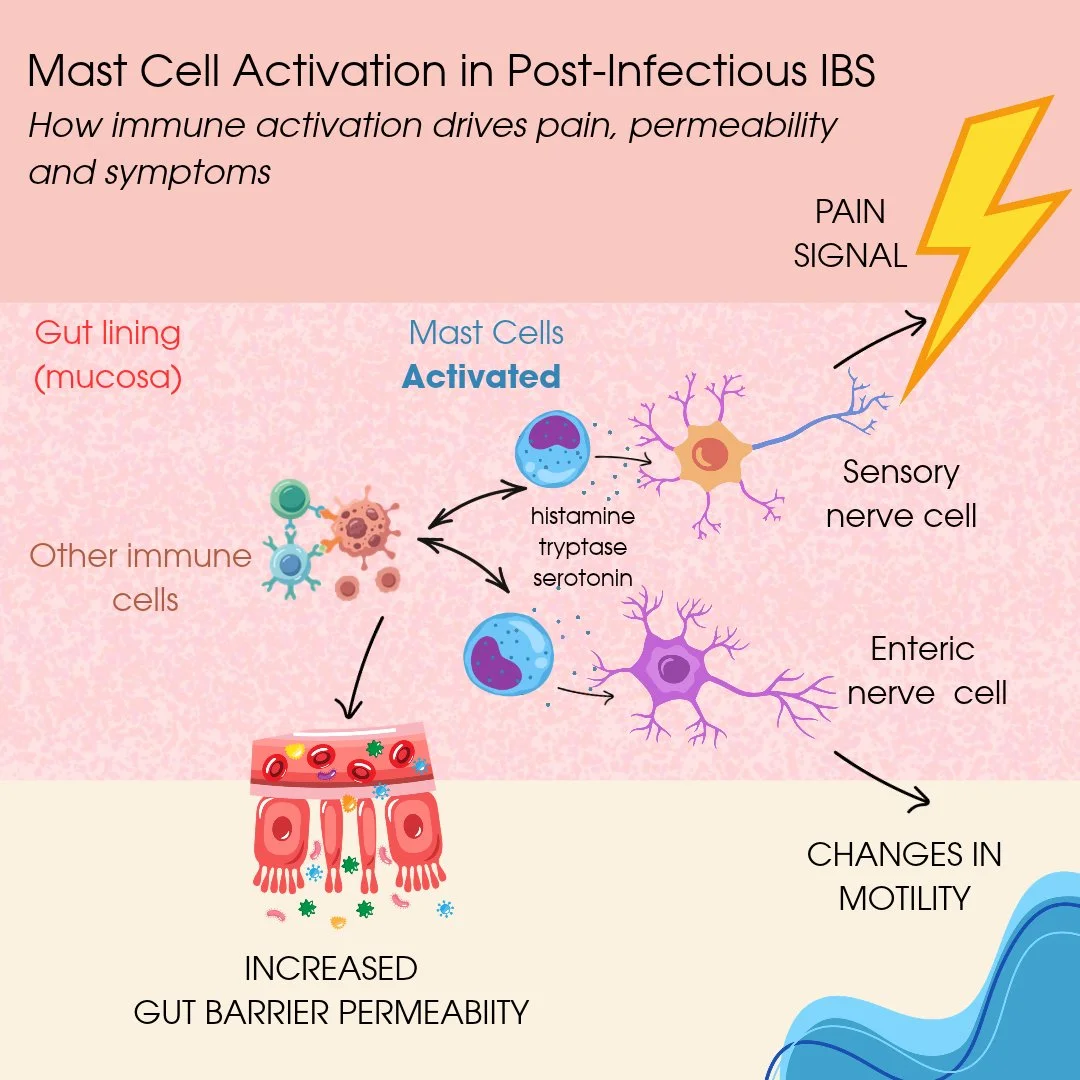
The theory is that IBS in this group is due to immune system dysregulation, specifically overreactive mast cells in the soft lining of the wall of the gut. Mast cells are the immune gatekeepers located in the lining of the intestine. They are often increased in number or show heightened activation in the small and large intestines of IBS patients (particularly IBS-D).
Crucially, these mast cells are frequently found lying in direct physical contact with or close to nerve fibres of the enteric nervous system (the second brain that controls the functions of the gut) and also close to sensory nerve fibres.
How Mast Cells Drive IBS Symptoms
It appears that the overreactive mast cells can lead to nerve sensitization. When triggered by stress, a gastro bug, or specific food antigens mast cells release inflammatory and other chemicals including histamine, tryptase, serotonin, and proteases. These chemicals excite nearby pain-sensing nerves leading to abnormal pain signaling (visceral sensitivity), changes in gut motility, and increased intestinal permeability.
All together these changes can affect how the bowel functions and how it feels.
Similar local immune response changes in the first part of small intestine may also explain why some people have dyspepsia symptoms soon after eating a meal.
Why FODMAPs Can Activate Mast Cells
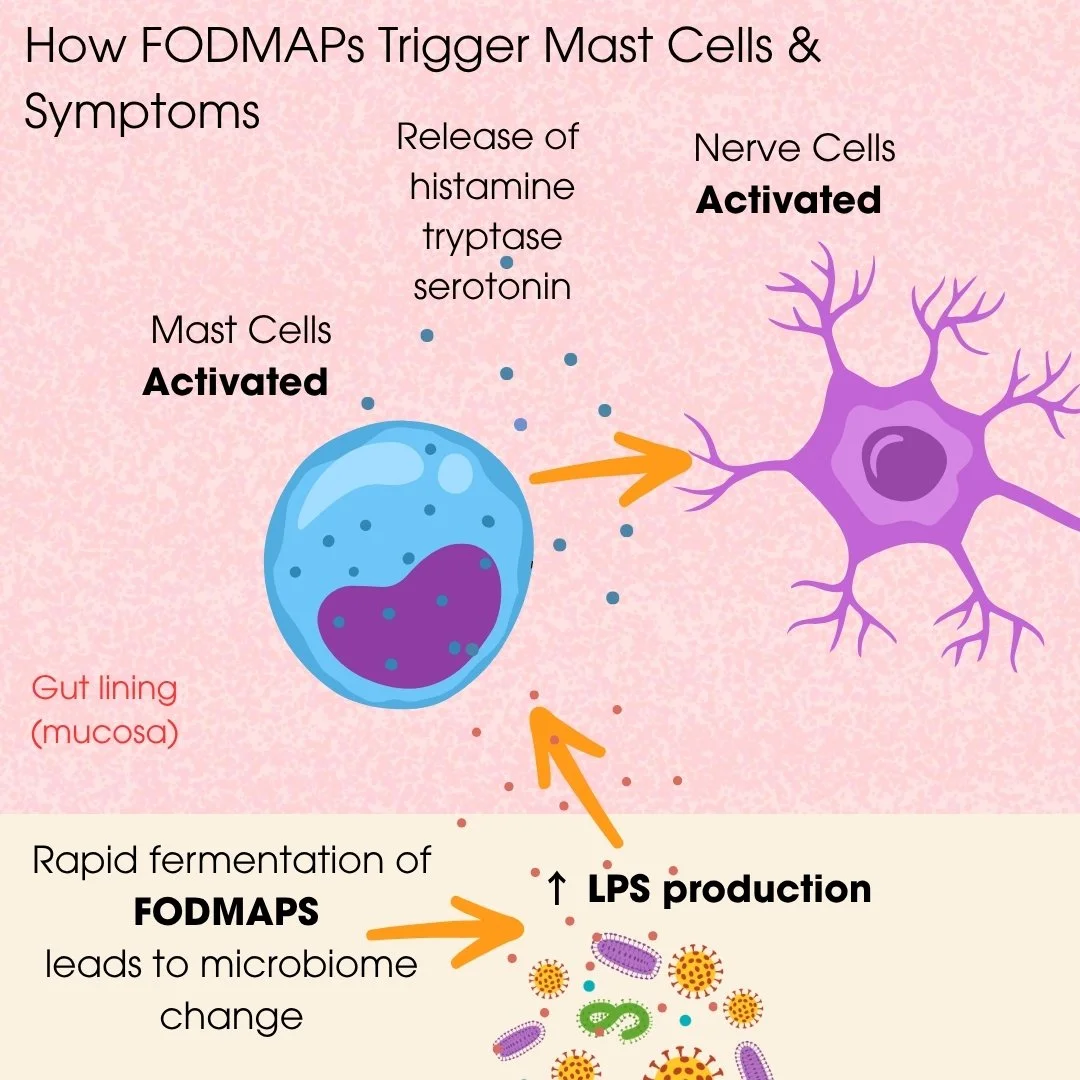
Interestingly, it appears that FODMAPs (rapidly fermented short chain carbohydrates) can also trigger activation of sensitive mast cells in the gut’s lining and the subsequent downstream cascade.
This is because FODMAPs cause changes in the gut microbiome that lead to increased production of lipopolysaccharids (LPS) by the bacteria. This triggers activation of the mast cells leading to sensitization of the nerves of the colon and increased intestinal permeability.
The Low FODMAP Diet: More Than Just Gas and Water
The low FODMAP diet which removes fermentable short chain carbohydrates is highly effective in managing IBS - it improves gut symptoms in around 70 % of people with IBS.
It was thought that the diet works be removing compounds that are rapidly fermented in the large intestine leading to a build-up of gas, perceived as painful distension in people with IBS or by removing compounds that draw water into the gut.
But it may be that the influence of the low FODMAP diet on inflammation is another mechanism that leads to a reduction in symptoms.
New Evidence: Low FODMAP Diet Reduces Mast Cell Activity
An American study published at the beginning of 2026 showed that when many people with IBS-D are placed on the low FODMAP diet they also have less mast cell activity within the gut, less inflammation within the gut and systemically and the gut barrier is stronger and less permeable.
For some people it may not be just about reducing gas or water in the intestines, it may also be about calming the immune system and reducing inflammation and calming the nerves in the gut.
What This Means for Future IBS Treatments
This is exciting because it raises the prospect of developing new treatments for IBS that target this inflammation pathway. Research is needed to evaluate the effectiveness of mast cell stabilizers, histamine H1-receptor antagonists, and anti-inflammatory or microbiota-modulating interventions.
In the meantime, it strengthens the evidence further supporting the use of the Low FODMAP diet to manage symptoms.
Could High Fibre and Other Anti‑Inflammatory Diets Help Too?
It also indicates that other diets that reduce inflammation in the gut may also be beneficial to reduce IBS symptoms in some people. This includes the anti-inflammatory diet mentioned by Josephine last week.
We also know that the Mediterranean diet, the gluten-free diet, low fat, and high fibre diets that lead to high levels of butyrate production reduce inflammation and that a polyphenol rich diet improves gut-barrier function. See our recent blog on this.
These effects may be through changes in mast cell activity or other elements of the immune system. There is strong evidence from cell and animal experiments that polyphenols and dietary fibre metabolites (butyrate) calm mast cells, but human trials looking specifically at the effects of these diets on mast cell activation in the lining of the gut have not yet been conducted.
Written by: Noisy Guts co-founder Dr Mary Webberley. Mary has a background in biology, with two degrees from the University of Cambridge and post-doctoral research experience.
References:
Walker, M. M., et al. (2009). Duodenal mastocytosis, eosinophilia and intraepithelial lymphocytosis as possible disease markers in the irritable bowel syndrome and functional dyspepsia. Alimentary pharmacology & therapeutics, 29(7), 765–773. https://doi.org/10.1111/j.1365-2036.2009.03937.x
Lee, K. N., & Lee, O. Y. (2016). The Role of Mast Cells in Irritable Bowel Syndrome. Gastroenterology research and practice, 2016, 2031480. https://doi.org/10.1155/2016/2031480
Singh, P., et al. (2021). High FODMAP diet causes barrier loss via lipopolysaccharide-mediated mast cell activation. JCI insight, 6(22), e146529. https://doi.org/10.1172/jci.insight.146529
Gao, J., et al. (2026). Low Fermentable Oligosaccharides, Disaccharides, Monosaccharides, and Polyols Diet Improves Colonic Barrier Function and Mast Cell Activation in Patients With Diarrhea-Predominant Irritable Bowel Syndrome: A Mechanistic Trial. Gastroenterology, 170(1), 132–147. https://doi.org/10.1053/j.gastro.2025.07.016
McIntosh, K., et al. (2017). FODMAPs alter symptoms and the metabolome of patients with IBS: a randomised controlled trial. Gut, 66(7), 1241–1251.Increased fermentable carbohydrate intake alters colonic mucus barrier function through glycation processes and increased mast cell counts PMID 35394686 https://doi.org/10.1136/gutjnl-2015-311339
Ford, A. C., Staudacher, H. M., & Talley, N. J. (2024). Postprandial symptoms in disorders of gut-brain interaction and their potential as a treatment target. Gut, 73(7), 1199–1211. https://doi.org/10.1136/gutjnl-2023-331833