
Changes in IBS Diagnosis
Last month there was an important publication in a major Gastroenterology Journal (see reference below). It highlighted changes to the recommended method diagnosis of Irritable Bowel Syndrome formulated by the Rome Group of expert gastroenterologists.
IBS diagnosis can be a controversial topic. For many years it was typically a diagnosis of exclusion…something arrived at after all other conditions - Crohn’s, colitis, cancer - had all been ruled out. This could leaving patients confused, out of pocket and somewhat exhausted by the diagnostic process.
The Rome group of gastroenterologists have done important work in changing the diagnosis into a ‘positive’ diagnosis - one made with conviction, without unnecessary diagnostic procedures and in a way that they hoped was more reassuring, and respectful to parents, and conducive to them trusting the diagnosis and confidently engaging in management or treatment. A much better starting point for their journey.
Why surveys?
One of the difficulties with diagnosing IBS, is that it doesn’t cause any biochemical or structural changes in the gut, just recurrent, highly unpleasant symptoms. Hence, the team developed a set of questions about the frequency of those symptoms that could identify patients with relatively high accuracy.
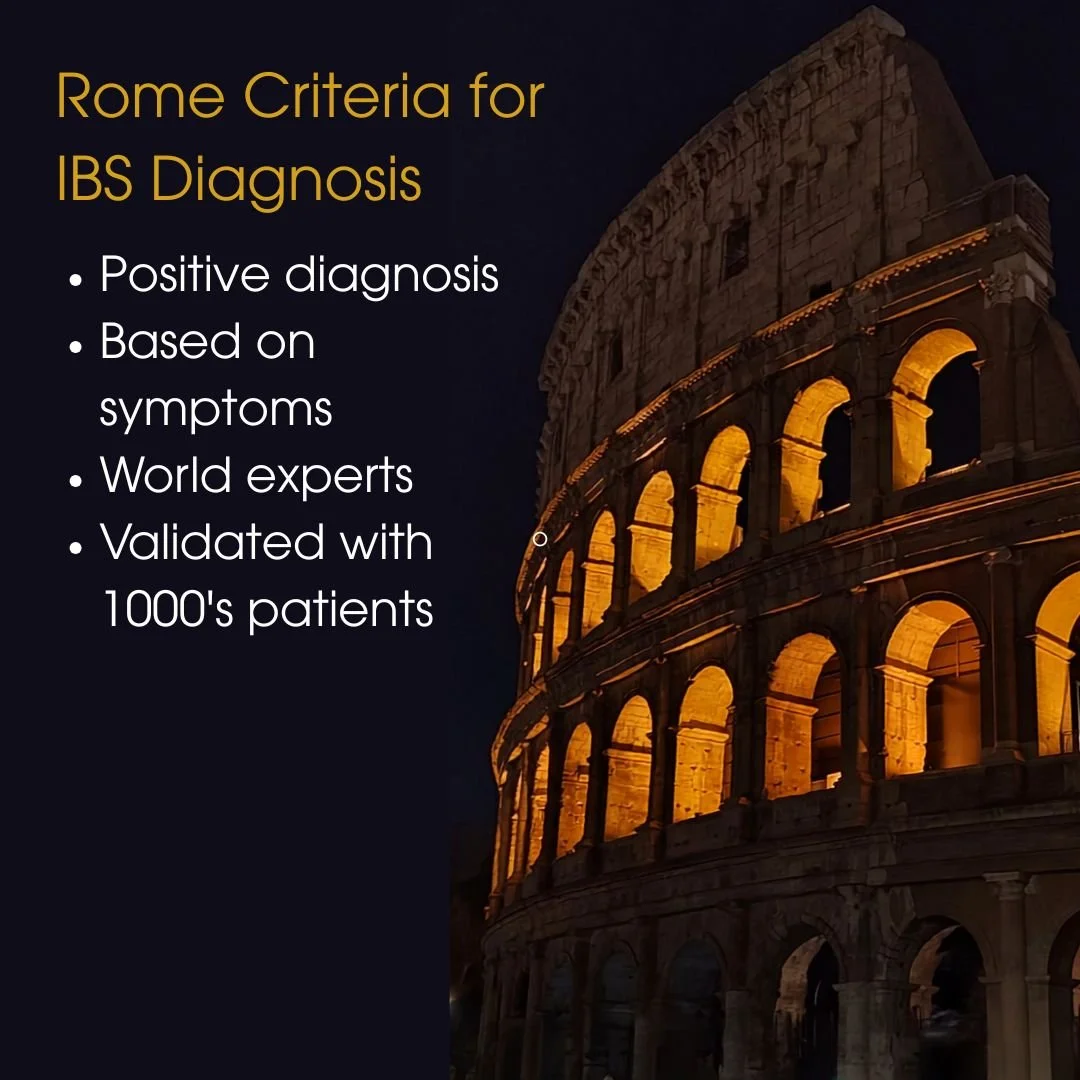
The first Rome Criteria were published in 1989..
… after a working group of gastroenterologists met in, yes, you guessed it, Rome in 1987 to prepare a draft that was then sent out to eminent IBS researchers in seven countries for feedback and refinement. It has been updated several times since then.
Josephine and I were very familiar with the Rome III and Rome IV criteria when we investigated the potential for using sound analysis for IBS diagnosis, back when we were working at the Marshall Centre.
The Rome III questionnaire was relatively simple. IBS was diagnosed if there was recurrent abdominal pain or discomfort three or more days per month in the last three months associated with two or more of:
improvement with defecation,
onset associated with a change in frequency of stool
onset associated with a change in form of stool
And the symptoms had been present for 6 months or more.
The last version of the criteria, the Rome IV criteria were published in 2016. This removed the word discomfort leaving just pain as a diagnostic signal.
The simple definition was - Recurrent abdominal pain on average at least 1 day per week in the last 3 months, associated with two or more of the following criteria:
Related to defecation
Associated with a change in frequency of stool
Associated with a change in form (appearance) of stool
*Criteria fulfilled for the last 3 months with symptom onset at least 6 months prior to diagnosis
This was overlaid with a complex questionnaire with six questions with % scales and a scoring algorithm, to precisely assess if patients met the cut-offs for symptom severity and frequency.
Since the Rome IV version however, there has been quite a lot of discussion in academic papers about whether the criteria was setting the bar too high, leaving out many people with IBS.
So what has changed with the latest update?
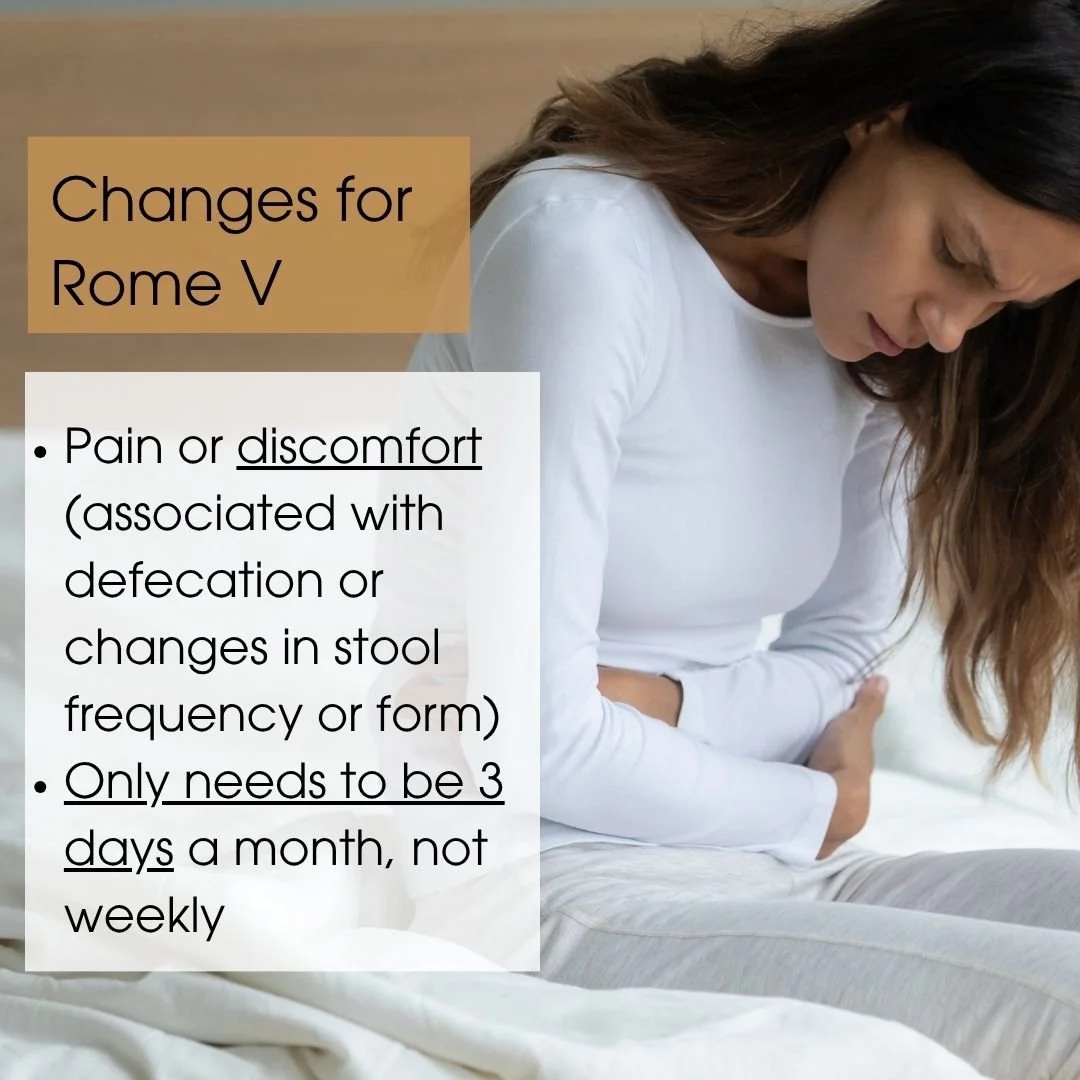
Not a lot. The changes are subtle.
In the Rome V update, they have reverted back to using discomfort as a signal as well as pain, reflecting how many people with IBS describe their symptoms. They have also lowered the threshold back down to symptoms on three days per month, replacing the more restrictive weekly rule from Rome IV. In many ways it is gone back to the Rome III version.
This change is based on input from many respected international experts and large-scale validation studies of the questionnaires.
We like the fact that it more clearly reflects the way patients describe their symptoms.
The new criteria also specify that the abdominal pain or discomfort should be recurrent, but not be continuous to differentiate IBS from centrally mediated abdominal pain syndrome, and that is should not only occur during a woman’s period to differentiate it from menstrual-related symptoms. Important considerations.
The Rome foundation have also more clearly separated out the short flexible clinical diagnostic criteria for IBS from the full research diagnostic questionnaire, with its tightly defined thresholds, recognizing that the goals of scientific researchers and patient care, while related, are not identical.
Finally, we note they have moved from describing IBS and similar conditions as ‘functional bowel disorders’ in Rome III, to ‘disorders of the gut-brain axis’ in Rome IV, to simply ‘bowel disorders’ in Rome V in 2026. This is less confusing and perhaps reflects the varies causes of IBS. The Rome team also feel it removes some stigma around the condition.
What would we have liked to see?
We would have liked to have seen the inclusion of bloating as one of the criteria, or at least some mention. The first Rome criteria did include the note that the pain associated with a change in stool form or frequency also commonly co-occurs with bloating or abdominal distension.
We also know from our research that bloating is one of the most common and bothersome symptoms for people with IBS.
Will it change what happens in practice?
It probably won’t change a lot in clinics.
In practice, the best GPs and gastroenterologist will continue to conduct limited blood and stool testing, conduct a physical exam to assess the tenderness of abdomen etc, and then ask general questions about symptoms gaining a view of whether they generally meet the duration and frequency cut-offs, and make a clinical judgement. Perhaps they will now get less hung up on whether the patients uses the word discomfort or pain, but we believe doctors have always been fairly flexible in their assessment.
The message also seems to have got through to most GPs that a positive diagnosis for IBS is possible and that colonoscopies and complex investigations are not always necessary, unless there are red flags.
The full Rome V questionnaire (like Rome IV before it) is behind a paywall – clinicians would need to purchase the full Rome V diagnostic criteria book which also covers other bowel disorders, or pay for their app to access them. Few are likely to do so. The Rome Foundation have acknowledged this by separating the clinical and research criteria this time around.
What about research trials?
In practice the full detailed questionnaires have only ever really been used by researchers deciding who should participate in clinical trials.
It is important to standardise the type of patients enrolled in studies testing the effectiveness of different treatments, so that researchers aren’t comparing apples and oranges, when they look across multiple studies.
Researchers also need to weigh up the fact that including patients with the most severe symptoms are more likely to show measurable improvement in symptoms in response to an effective treatment, but this may not reflect the response of the general IBS population. Standardising inclusion of study participants at this sweet spot was one of the motivating factors for the original Rome working group.
Most clinical trials also use standardised ‘tool’s such as the IBS symptom severity survey to look at changes in symptoms, and these do include abdominal distension or bloating. Yay!
What do we like about the update?

One of the best things about the open access paper about the update is that it puts the diagnostic criteria into the full context of IBS diagnosis and treatment.
For example, it outlines the physical examinations and baseline pathology tests that should always be carried out to exclude gastrointestinal conditions with similar symptoms (complete blood count to rule out anaemia, C-reactive protein, coeliac serology). These need to go hand in hand with the positive IBS diagnosis that comes from the Rome criteria. For most people further investigations aren’t needed.
But it also outlines the red flags that signal that more complex investigations like colonoscopies should be carried out, such as blood in the stool; onset over 50; family history of colon cancer, Crohn’s or colitis; weight loss, nighttime or severe watery diarrhoea, etc. And when to consider testing to rule out infections and Bile Acid Malabsorption.
This is all extremely helpful for GPs and gastroenterologists, particularly because they have outlined this info in easy to digest infographics, and it is based on the latest research.

The authors also describe the optimal stepwise progression for patient-centred, multi-disciplinary care for IBS patients.
This runs from Positive Diagnosis and Explanation through to Dietary Advice (including the Low FODMAP diet and probiotics), through to Medications, and Brain-Gut Directed Therapies such as Cognitive Behavioural Therapy and Hypnotherapy.
Hopefully, the publication will aid in moving this gold standard, multi-disciplinary care to the mainstream. Just as growing awareness of the Rome criteria over the last few decades has increased awareness amongst doctors of the value of providing a clear positive diagnosis to patients.
Blog written by: Noisy Guts co-founder Dr Mary Webberley. Mary has a background in biology, with two degrees from the University of Cambridge and post-doctoral research experience.
Reference: Corsetti, M., Shin, A., Lacy, B. E., Cash, B. D., Simrén, M., Schmulson, M. J., Hou, X., & Lembo, A. (2026). Bowel Disorders. Gastroenterology, 170(6), 1261–1282. https://doi.org/10.1053/j.gastro.2026.02.003