
What Can We Learn About Gut Health from the Ancient Greeks and Romans?
With The Odyssey the current hot ticket in cinemas, Tom Hiddleston hosting a new documentary on Pompeii, and Professor Mary Beard - the world’s most famous Ancient History Professor (and, incidentally, Tom Hiddleston’s supervisor when he studied Classics at Cambridge) - planning a down‑under tour, all things ancient are having a moment.
And because I love a good movie, I’m a bit of a history buff, and gut health is my professional obsession, I’ve decided to put all three together in this week’s blog.
It answers the question: What did the Ancient Greeks and Romans eat for digestive wellbeing and what can we learn from them today?
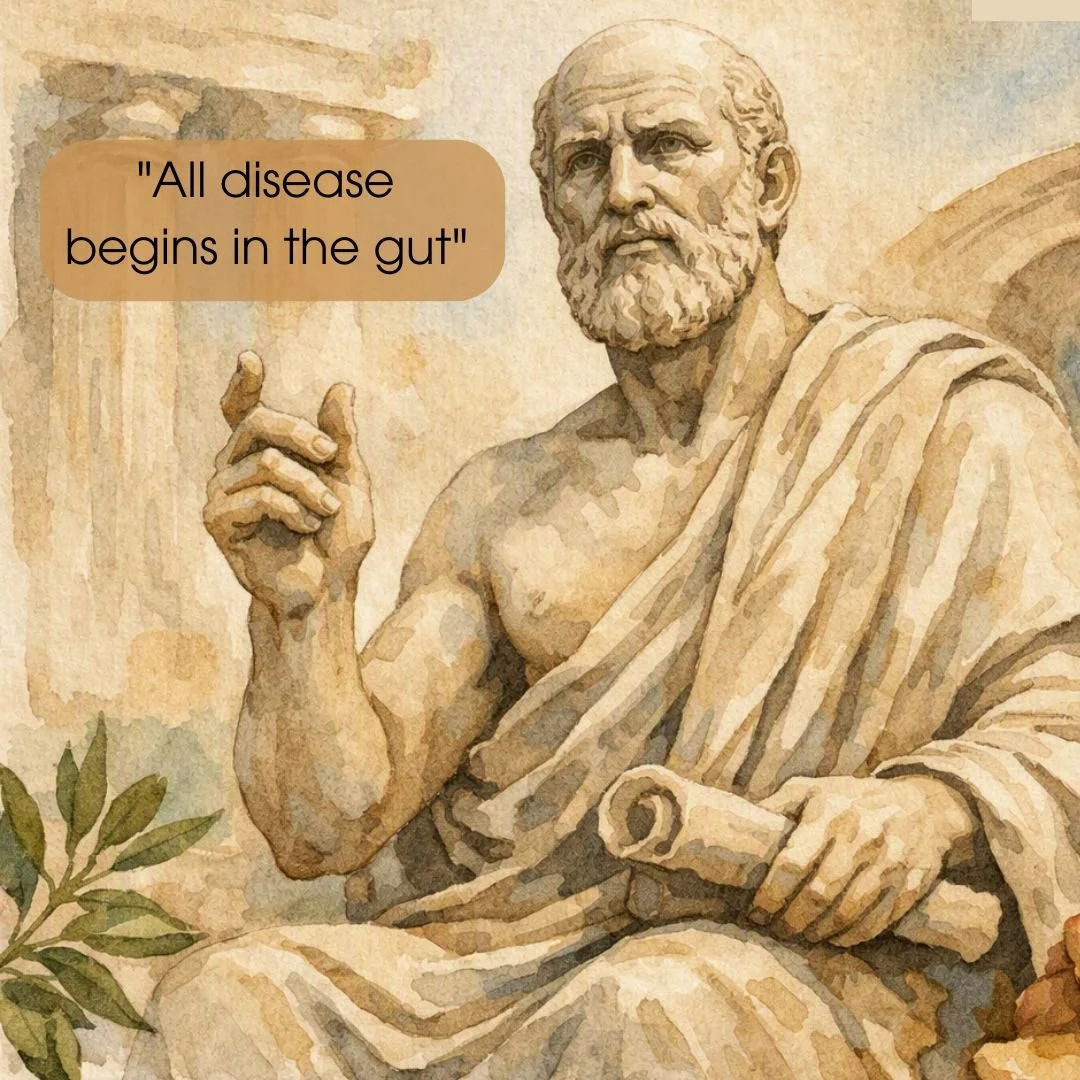
To understand their approach to food and digestion, we need to start with Hippocrates.
Long before anyone talked about microbiomes, probiotics, or FODMAPs, Hippocrates was already arguing that good digestion was the foundation of good health. He was famous for the instruction, “Let food be thy medicine” . He believed that food had intrinsic “powers” that could strengthen or weaken the body, and that choosing the right foods for the season, the person, and the condition was essential for preventing disease.
While Hippocrates didn’t know about gut bacteria, his dietary suggestions map surprisingly well onto modern gut‑health science: whole foods, seasonal produce, fermentation, fibre, herbs, and healthy fats. These elements shaped the eating patterns of both the Ancient Greeks and the Roman. These two cultures had diets that shared gut‑friendly elements, yet they were still distinct in their flavours and daily staples.
Let’s explore what they ate, why it mattered, and which ingredients remain gut‑friendly (and low FODMAP) today.
Gut‑Friendly Foods in the Ancient Greek Diet
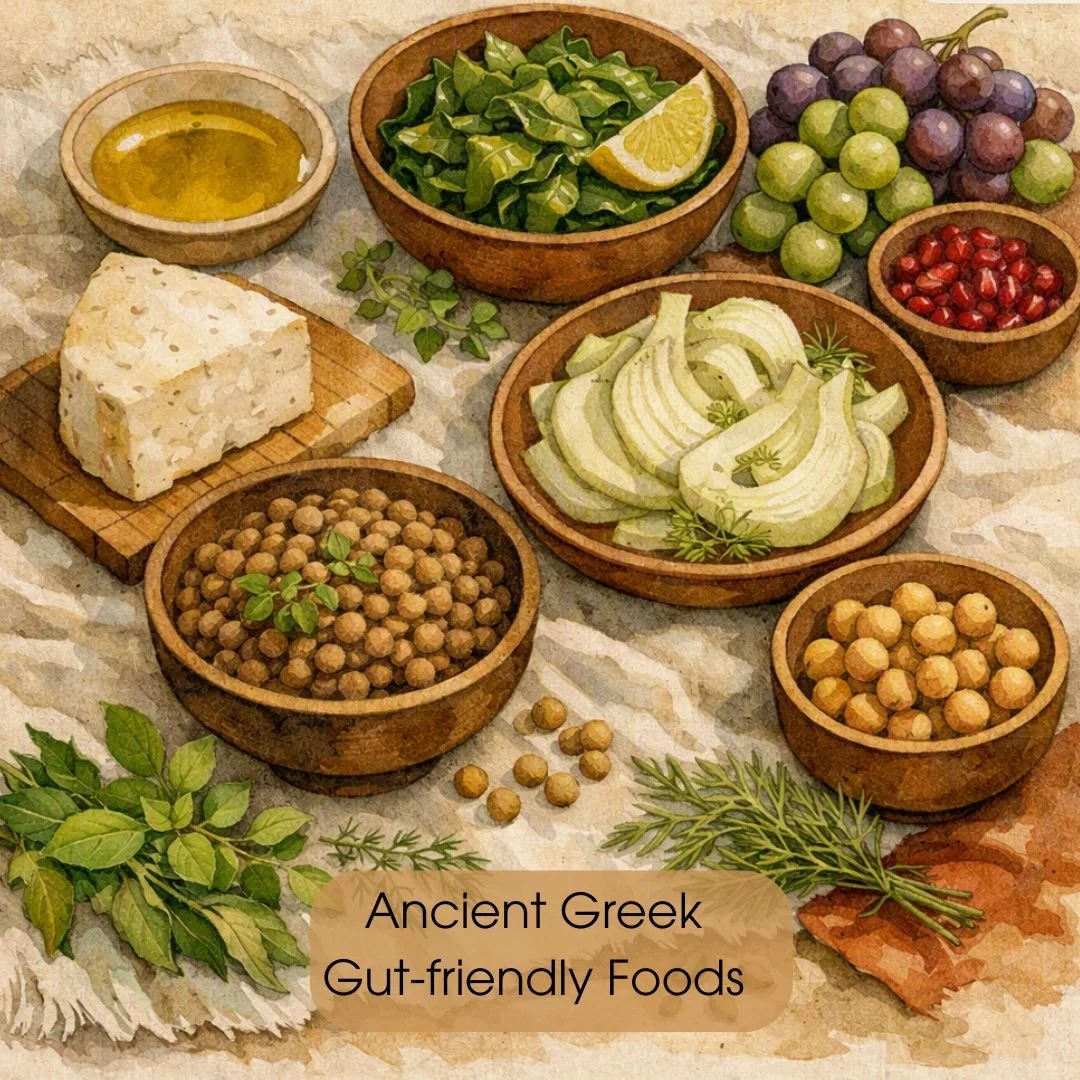
The ancient Greek diet was built around whole foods, seasonal produce, and simple preparations. Many of their everyday staples are now recognised as excellent for digestive health.
Fermented Foods (Natural Probiotics)
The Ancient Greeks consumed fermented goat and sheep dairy, early forms of yoghurt and cultured milk, along with pickled vegetables and herbs. They also used vinegar in marinades and to pickle vegetables and meats. These fermented foods introduced beneficial bacteria and organic acids that supported digestion. Low FODMAP examples: hard goat cheese, lactose-free dairy, small amounts of fermented vegetables.
Legumes (Prebiotic Fibre)
Legumes were central to Ancient Greek nutrition: lentils, chickpeas, and fava beans appeared in soups, stews, and porridges. This porridge or thick mash was called etnos and was a daily staple for both poor workers and rich citizens. People seasoned it with olive oil and simple herbs. Legumes rich in fermentable fibres that feed beneficial gut bacteria. Low FODMAP options: small portions (¼ cup) of canned lentils or chickpeas (well rinsed).
Ancient Grains
Barley, emmer, einkorn, and spelt were consumed frequently. For example, Maza was a staple food consisting of roasted barley flour mixed with liquids like water, wine, or milk, and often shaped into simple cakes or dough.
All these grains contain insoluble and soluble fibre and polyphenols that improve regularity, support microbial diversity and the integrity of the gut lining. However all are high in FODMAPs.
Wild Greens & Vegetables
Greeks ate a wide variety of wild greens (horta) and cultivated vegetables: fennel, leeks, onions, cabbage, radishes, chicory. Wild greens would have provides a fabulous range of beneficial fibre, vitamins, minerals and other phytochemicals. The fennel, leeks, onions, cabbage provide forms of prebiotic fibre (inulin and other fructans) that can be great for a robust gut, but tend to be too rapidly fermented for a sensitive IBS tummy. They also enjoyed dandelion, and purslane. Whilst oregano, thyme, dill, and mint added mild antimicrobial and digestive benefits. Low FODMAP options: 75g of radish or cabbage, greens like spinach and rocket, the green tops of spring onions, and the herbs mint, dill, and thyme.
Fruit & Medicinal Berries
Figs, grapes, apples, and pomegranates were common. Sea buckthorn, used medicinally, offered anti‑inflammatory and digestive benefits. Low FODMAP options: Swap the grapes, pomegranates and apples for other fruit and berries with large low FODMAP serving sizes, like kiwifruit, blueberries, raspberries (⅓ cup) and strawberries (5 medium). They are great sources of anthocyanins and other polyphenols that your gut bacteria love. Want a quick and easy top-up? Our Berries+ Daily Gut Health Boost has real berry powders, plus gentle prebiotic fibre and a probiotic.
Olive Oil
Olive oil was the primary fat and was of the most gut‑supportive ingredients in the diet due to its polyphenols and anti‑inflammatory effects. The polyphenols provide food for healthy microbes like Lactobacillus and Bifidobacterium and reduce levels of harmful gut bacteria. Low FODMAP: yes, and extra virgin olive oil is still a staple of the modern Mediterranean diet, renowned for its positive health effects.
Fish & Cultured Cheeses
Small oily fish (sardines, mackerel) provided omega‑3s, while naturally cultured cheeses added mild fermentation. Low FODMAP options: most hard cheeses, sardines canned in oil.
Gut‑Friendly Foods in the Ancient Roman Diet (Pompeii Era)
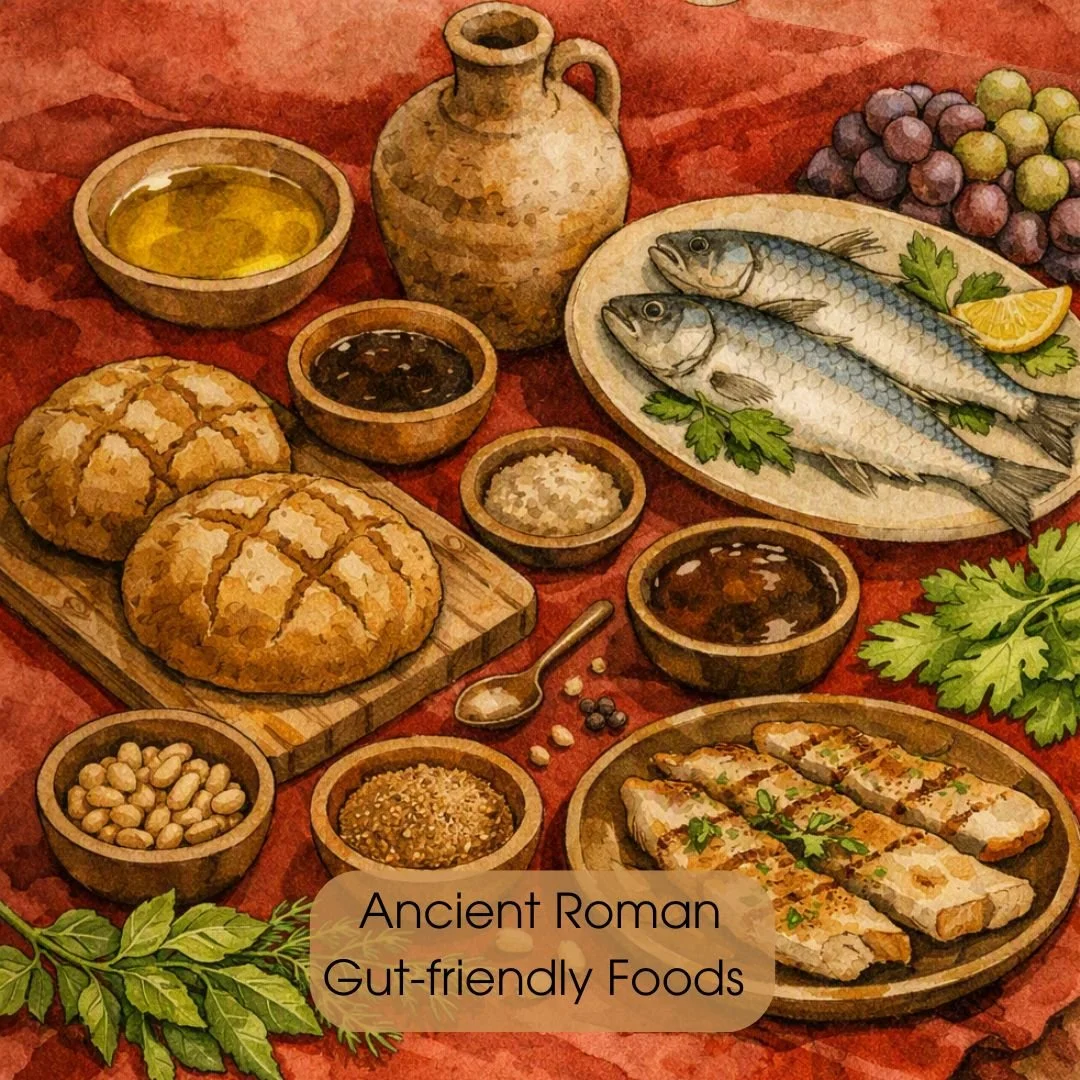
The Roman diet of the early Imperial period was remarkably similar to the Greek diet - heavy on plants, fibre‑rich, and full of fermented foods. But several distinctive elements set it apart.
Fermented Foods: Garum & Sourdough
Romans consumed garum, a fermented fish sauce used in almost every savoury dish. Long fermentation produced amino acids, minerals, and likely probiotic bacteria. Coastal towns like Pompeii had large cetaria - industrial complexes for making garum. I think of the Ancient Romans’ love of garum every time I add Worcestershire Sauce to a Bolognaise sauce or a stew. It is a much more modern invention, but it does contain fermented anchovies, plus aromatics and vinegar.
Like the Greeks, the Romans used vinegar for preserving and as a medicine. And Roman soldiers mixed vinegar with water to create a refreshing, safe daily drink.
The Romans also relied heavily on sourdough bread, which improves digestibility and reduces FODMAP content. Low FODMAP options: sourdough bread (2 slices), small amounts (1 tbsp) of fish sauce and Worcestershire Sauce.
Legumes
Like the Greeks, Romans ate lentils, chickpeas, and broad beans. These were essential for poorer households and soldiers. Low FODMAP options: small portions (¼ cup) of canned lentils/chickpeas (well rinsed).
Whole Grains
Romans consumed emmer wheat, spelt, barley, and millet, mostly in unrefined forms. Their staple dish, puls, was a grain‑based porridge similar to Greek maza. Low FODMAP options: sourdough bread ( 2 slices)
Vegetables & Greens
Like the Ancients Greeks, the Romans also enjoyed vegetables. Pompeii’s gardens were full of cabbage, leeks, onions, garlic, turnips, radishes, chicory, beet greens, fennel, and celery. Cabbage was especially prized; Cato the Elder wrote about its digestive and medicinal benefits.
Unlike the modern Mediterranean diet - tomatoes were not consumed. Tomatoes arrived in Italy during the mid-16th century after Spanish explorers brought them from the Americas.
Low FODMAP options: cabbage (75g), radish (75g), fennel bulb (75g), fennel fronds (15g), chicory leaves (75g). Or try our Greens+ Daily Gut Health Boost.
Fruit & Nuts
Romans enjoyed figs, dates, apples, pears, grapes, and pomegranates. Walnuts, almonds, and pine nuts were all common and they also enjoyed chestnuts. All are rich in fibre. Low FODMAP options: again we’d swap to berries for larger low FODMAP serving sizes. The nuts with the most generous low FODMAP serving sizes are macadamias, walnuts, pecans and chestnuts.
Olive Oil & Fish
Olive oil remained the dominant fat, and fish was abundant in coastal cities like Pompeii. Low FODMAP: Yes.
Dairy
Romans consumed mostly sheep and goat cheese, often lightly fermented. Low FODMAP option: hard cheeses.
Subtle differences Between Greek and Roman Gut‑Friendly Eating
Although the diets overlap heavily, there are some subtle differences
1. Fermentation Culture
Greeks: fermented dairy and pickled vegetables.
Romans: garum and sourdough bread were far more dominant.
2. Bread & Grains
Greeks: barley was king; bread was less central.
Romans: bread was a daily staple, especially sourdough loaves.
3. Herbs
Greeks: oregano, thyme, dill, mint.
Romans: lovage, rue, coriander, celery seed
4. Vegetables
Greeks: wild greens and foraged plants.
Romans: cultivated vegetables from organised kitchen gardens.
5. Sauces & Seasonings
Greeks: simpler seasoning, olive oil, herbs.
Romans: garum, vinegar, wine reductions - all adding fermentation and acidity.
Why the Greek and Roman Diets Were Gut‑Friendly
Both diets were naturally aligned with what modern science recognises as important for gut health:
High fibre: legumes, grains, vegetables, wild greens.
Natural fermentation: yoghurt, pickles, garum, sourdough for probiotics.
Polyphenols: olive oil, herbs, fruits, wine.
Anti‑inflammatory fats: olive oil, oily fish (and less red meat).
Minimal processing: everything was whole, seasonal and fresh.
Low FODMAP options were abundant: greens, olive oil, sourdough, hard cheeses, fish.
People in both cultures drank wine daily. However, this was usually well diluted with water, and often flavoured with honey, spices or herbs - for example the Ancient Greeks would some times add pine resin (similar to modern retsina). Drinking wine straight was considered uncivilised. Whilst alcohol is generally not viewed as good for gut health today, it may have helped to kill pathogens in the water and reduce the risk of waterborne illnesses like dysentery.
In Conclusion
The ancient Mediterranean tables were a masterclass in gut‑friendly eating. This wasn’t because the Ancient Greeks or Romans understood microbiomes, but because their food culture was built around whole ingredients, especially a variety of plant-based foods including legumes, fruits, greens and wholegrains, plus fermented foods and olive oil.
I find it helpful to see that two different styles of cooking hundred of years apart still exploited the same gut health elements. It’s an indication that whatever your preferred cuisine, you can focus on specific ingredients to benefit you and your gut microbiome.
Please let us know if you find something in the ancient Roman or Greek style of cooking that inspires you.
Maybe to honour the Ancients, you might like to try our hummus recipes for an updated version of the Greek etnos, or you might simply add in a couple of slices of sourdough reminiscent of the Ancient Roman’s daily bread. You may want to add a splash of Worcestershire sauce to your next bolognaise, and we think that just about every meal can benefit from the addition of a fresh green salad.
Written by: Noisy Guts co-founder Dr Mary Webberley. Mary has a background in biology, with two degrees from the University of Cambridge and post-doctoral research experience. She also enjoys a good movie and reading about history.