
Kiwifruit, Sleep and Mood
Most people know kiwifruit as a bright, tangy little powerhouse of vitamin C. If you’ve been a Noisy Guts follower for a while, you will know that kiwifruit are also great for gut health. Kiwifruit feature as one of the stars in our Best Ever Poop program, and two of our favourite recipes are the Kiwi Chia Pots and the Kiwi Vanilla Glow Smoothie.

Two kiwifruit a day provide 4g of low FODMAP fibre and are proven to reduce constipation and may also help prevent colon cancer. However, there is growing evidence that kiwifruit can help with more than gut health.
Kiwifruit may play a meaningful role in supporting better sleep and mood. From elite athletes to university students with insomnia, several studies now point to consistent benefits. And while the science is still emerging (the studies so far have been small or had less than ideal set-ups), the early signals are compelling.
What the Research Shows About Kiwifruit and Sleep
Interest in kiwifruit as a “sleep-supporting food” began with a small study in 2011. Lin and colleagues studied 24 adults with self‑reported sleep problems. They ate two green kiwifruit one hour before bed for four weeks and experienced significant improvements in total sleep time, sleep efficiency, and sleep onset latency. In other words, they fell asleep faster, stayed asleep longer, and slept more soundly. The study used both subjective sleep measures, and objective analysis of sleep time (through something called actigraphy), but it had no control of placebo, just a comparison between before and after the addition of kiwifruit to the diet.
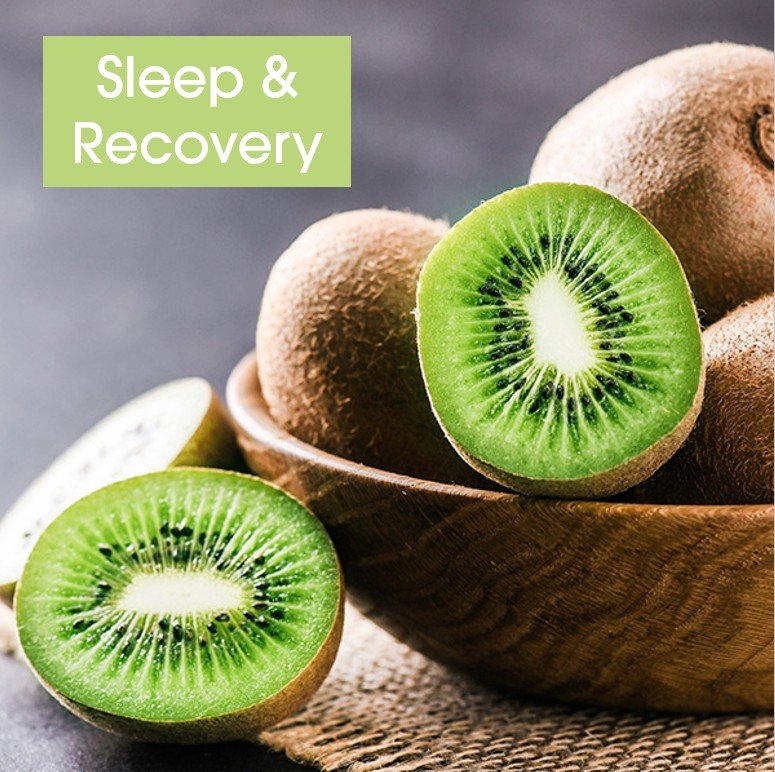
A follow‑up 2017 trial in a younger population was a little larger and had a stronger design. Sixty-seven university students with chronic insomnia were randomly allocated to two groups. One group received 130g of pear, the other group received 130g of kiwifruit one hour before bed for four weeks. The kiwifruit group experienced improvements in subjective sleep quality and daytime functioning compared to the pear group, but the differences were not reflected in objective sleep measures.
Elite athletes have also entered the picture. Athletes are particularly prone to sleep disturbances due to training frequency, travel and anxiety. They seek rapid recovery and natural interventions, i.e., a food first approach. Doherty and colleagues conducted a study reported in to (2023) to see if kiwifruit might fit the bill. They found that consuming two green kiwifruit one hour before bed for four weeks improved sleep quality and reduced perceived fatigue in elite athletes during heavy training blocks. However, the study was small (24 participants) and unfortunately, due to the fact that it was conducted during the height of the COVID pandemic, no objective sleep measures were made.
Another study published in 2023 by Kanon and colleagues looked at the effects of both fresh and dried kiwifruit on sleep and mood. They also measured metabolites related to melatonin, serotonin, vitamin C, and B‑vitamins in the urine to give us some ideas for how the might kiwifruit might work (see below). Healthy young men, both good and poor sleepers consumed 2 fresh kiwifruit, 32 g of dried kiwifruit or water after a standard meal about 4 hours before bed in a random order each separated by a few days. Kiwifruit consumption was associated with modest improvements in subjective sleepiness, and alertness on waking. The effects were greater for the dried kiwifruit, which included the skin.
What About Mood?
Many of us know that sleep and mood are deeply intertwined. Kanon’s team reported modest improvements in subjective mood states especially vigour following dried kiwifruit consumption, particularly in participants with poorer baseline sleep. This may reflect serotonin‑related pathways or simply the downstream effects of better sleep quality.
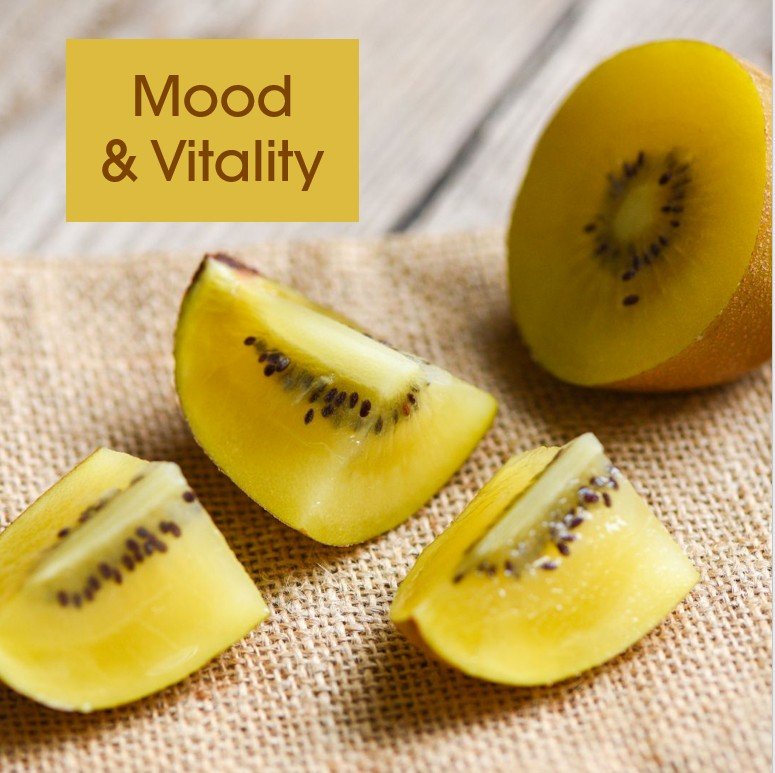
Other research has explored kiwifruit’s impact on psychological wellbeing more broadly. Two studies have found that that consuming two golden kiwifruit per day for several weeks can improve various measures of mood and vitality in young adults.
The authors attributed these effects to the fruit’s high vitamin C content, which plays a role in neurotransmitter synthesis and stress regulation.
How Might Kiwifruit Influence Sleep and Mood?
The mechanisms are still being mapped out, but there are several possible pathways.

1. Serotonin and Melatonin
Green kiwifruit contains melatonin the hormone that governs sleep-wake cycles and serotonin, a neurotransmitter involved in mood regulation and also a precursor for melatonin production. Kanon’s team found changes in urinary metabolites of serotonin and melatonin after kiwifruit consumption, suggesting that the fruit may influence these pathways. Consumption of kiwifruit in the evening may be important to effectively aid sleep.
2. Antioxidants and Reduced Inflammation
Kiwifruit are exceptionally rich in vitamin C and polyphenols. Oxidative stress and inflammation are increasingly recognised as contributors to sleep disturbances. Antioxidant‑rich foods like kiwifruit may help buffer these effects, and vitamin C is thought to be key to improvements in mood.
3. Folate and B-Vitamins
Deficiencies in folate and certain B‑vitamins have been linked to insomnia, fatigue, and low mood. For example, folate deficiency is linked to restless leg syndrome, which can disturb sleep. Kiwifruit naturally contain folate and B‑vitamins, and Kanon’s group also observed shifts in urinary B‑vitamin metabolites following consumption. This suggests a potential micronutrient‑mediated pathway.
4. Fibre and the Gut–Brain Axis
The fibre in kiwifruit, particularly pectin, may influence sleep and mood through the gut–brain axis. Prebiotic fibres can change the gut microbiota, which in turn influence neurotransmitter production, inflammation, and circadian rhythms. While this mechanism is still theoretical in the context of kiwifruit, it aligns with broader gut-brain research.
5. Blood Sugar Stability
Kiwifruit has a low glycaemic load and contains both soluble and insoluble fibre. Stable blood glucose levels in the evening may support more consistent sleep patterns, especially in people sensitive to night-time glucose fluctuations.
Takeaway
Kiwifruit isn’t a magic sleep cure, but the evidence so far is promising: eating two kiwifruit in the evening may support better sleep quality, faster sleep onset, and improved mood, especially in people with sleep difficulties.
The mechanisms likely involve a combination of serotonin and melatonin availability, antioxidant activity, micronutrient support, and gut-brain interactions. Certainly, larger more comprehensive research studies are needed, but kiwifruit stands out as one of the few foods with early clinical evidence for sleep benefits.
And the best part? They are a delicious, low‑risk addition to your evening routine.
Certainly, if you are already eating a couple of kiwifruits each day to ward off constipation and you also want to improve your sleep, you may want to try moving them from the breakfast menu to after dinner.
Blog written by: Noisy Guts co-founder Dr Mary Webberley. Mary has a background in biology, with two degrees from the University of Cambridge and post-doctoral research experience.
References:
Gearry, R., et al. (2023) Consumption of 2 Green Kiwifruits Daily Improves Constipation and Abdominal Comfort-Results of an International Multicenter Randomized Controlled Trial. The American journal of gastroenterology, 118(6), 1058–1068. https://doi.org/10.14309/ajg.0000000000002124
Wu, Z. Y., et al. (2023) Different types of fruit intake and colorectal cancer risk: A meta-analysis of observational studies. World journal of gastroenterology, 29(17), 2679–2700. https://doi.org/10.3748/wjg.v29.i17.2679
Lin, H., et al. (2011) Effect of Kiwifruit consumption on sleep quality in adults with sleep problems. Asia Pac. J.Clin. Nutr. 20, 169–174. [PubMed]
Doherty, R., et al. (2023) The Impact of Kiwifruit Consumption on the Sleep and Recovery of Elite Athletes. Nutrients, 15(10), 2274. https://doi.org/10.3390/nu15102274
Kanon, A. P., et al. (2023) Acute effects of fresh versus dried Hayward green kiwifruit on sleep quality, mood, and sleep-related urinary metabolites in healthy young men with good and poor sleep quality. Frontiers in nutrition, 10, 1079609. https://doi.org/10.3389/fnut.2023.1079609
Nødtvedt, Ø.O., et al. (2017) The effects of kiwi fruit consumption in students with chronic insomnia symptoms: A randomized controlled trial. Sleep Biol. Rhythm. 2017, 15, 159–166.
Conner, T. S., et al. (2020) KiwiC for Vitality: Results of a Randomized Placebo-Controlled Trial Testing the Effects of Kiwifruit or Vitamin C Tablets on Vitality in Adults with Low Vitamin C Levels. Nutrients, 12(9), 2898. https://doi.org/10.3390/nu12092898
Carr, A. C., et al. (2013) Mood improvement in young adult males following supplementation with gold kiwifruit, a high-vitamin C food. Journal of nutritional science, 2, e24. https://doi.org/10.1017/jns.2013.12