
Why so many people can't identify their IBS triggers (and what to do next)
"I've Tried Everything… There Just Isn't a Pattern."
Last weekend I was chatting with my niece's husband about his gut. He's been experiencing bloating, excessive gas and constipation. While he’s still undergoing further investigations, his healthcare team suspect it might be IBS. Naturally, the conversation turned to the low FODMAP diet.
"So have you worked out what triggers you?" I asked.
He shrugged.
"Honestly... no. I've tried. One day I can eat something and I'm fine. The next time I'm not. I just can't see any patterns."
I suspect that many of you reading this are nodding your head. Does this sound familiar?
“Some days I react, some days I don't”.
“Everything seems to upset my gut”.
“I've stopped eating so many foods and I'm still bloated”.
If this sounds like you, here’s why you might be having trouble identifying your triggers and what you can do about it.
Q: Why can't I identify my trigger foods?
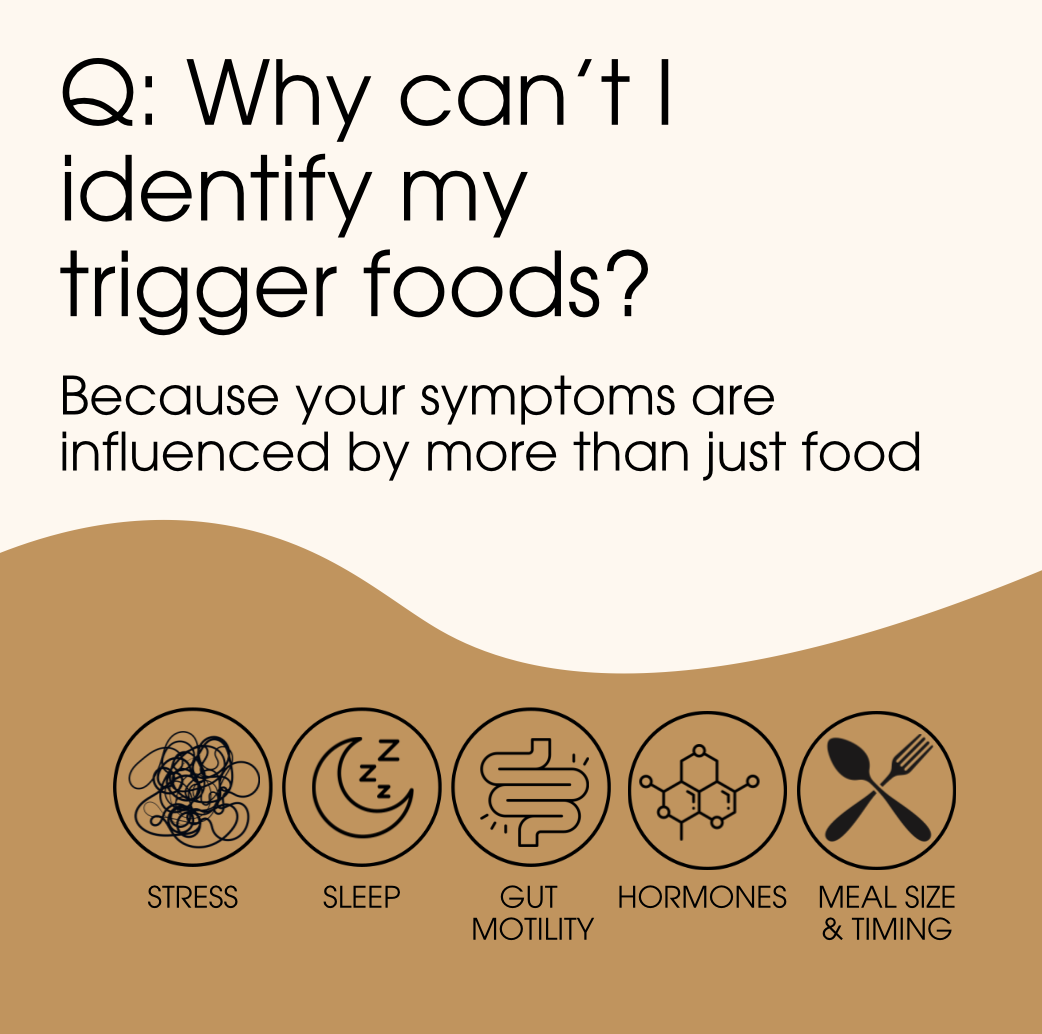
Why can’t I identify my trigger foods? Because your symptoms are influenced by more than just food.
Because IBS isn't like a food allergy. With a peanut allergy, the relationship is relatively straightforward: Eat peanut. Reaction. Resolution.
IBS doesn't work that way.
Your symptoms are influenced by your food plus your stress levels, sleep, hormones, gut motility, visceral hypersensitivity, meal size and even what you ate earlier in the day. IBS is a relapsing and remitting condition, meaning symptoms naturally flare and settle over time rather than following a simple, predictable pattern.
That means today's avocado might be perfectly fine. The same avocado after three poor nights' sleep, a stressful week and takeaway pizza and a few beers the night before might be enough to trigger symptoms.
Q: Do I have to keep a food diary of everything I eat?
Is a food diary helpful in identifying food triggers? Yes - if you know what you’re looking for.
Maybe. Food diaries can be really helpful, but they're rarely enough on their own. Why? Because to an untrained eye, you might not see the whole picture. Most meals contain multiple FODMAPs. Imagine you eat an Italian meal - pasta carbonara, garlic bread and a side salad: wheat pasta, garlic, onion, mushrooms, bacon, egg, cheese, cream and the list goes on…
Which ingredient caused the problem? Who knows!
Plus, the total FODMAP load matters, not just individual foods. Foods containing multiple FODMAPs, or eating several moderate-FODMAP foods together, can push your gut beyond its tolerance, making patterns difficult to recognise. So yes, keeping a food diary is helpful because it helps identify patterns - as long as you know what you’re looking for!
Q: Can't I just cut out the foods I think are causing problems?
Cutting out foods from your diet haphazardly can lead to an unnecessarily restricted diet that’s not beneficial to your microbiome.
That's exactly what many people do. The trouble is, this approach often leads to an unnecessarily restricted diet. According to a review by Hayes and colleagues (2014), nearly two-thirds of people with IBS had already restricted or eliminated foods from their diet in an attempt to manage their symptoms. More than one in ten were considered at risk of nutritional inadequacy because of those restrictions.
I've seen this time and time again. People eliminate dairy. Then wheat. Then fruit. Then vegetables. Eventually they're living on plain chicken and rice...and they're still bloated.
Q: So why does the Low FODMAP diet work?
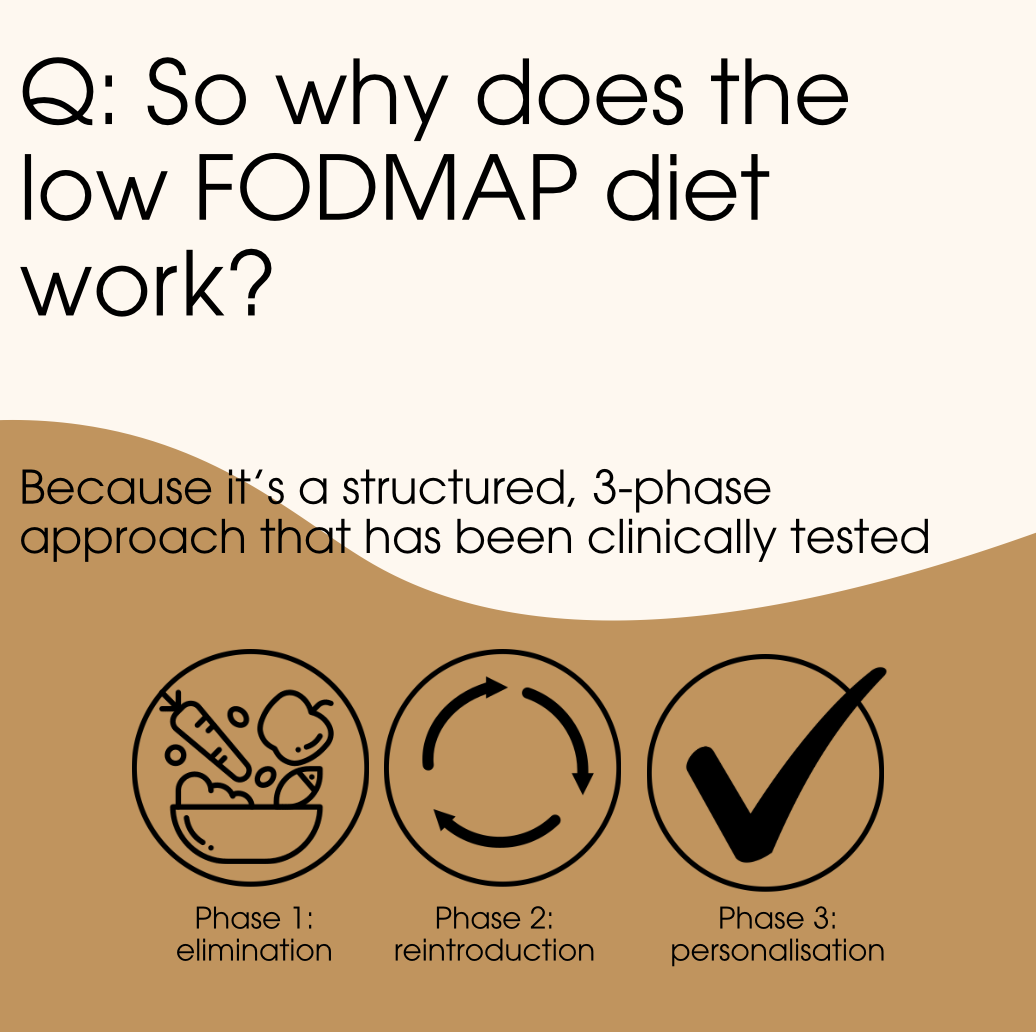
Research suggests that 70-75% of people with IBS experience a meaningful improvement in symptoms when they follow the Low FODMAP diet
Because it's structured. Instead of randomly removing foods, the low FODMAP diet temporarily reduces all major FODMAP groups for a short period before systematically reintroducing them one at a time.
The low FODMAP diet is one of the most effective dietary therapies available for IBS. Research suggests that around 70–75% of people experience a meaningful improvement in symptoms when they follow the diet correctly. So there’s a good chance that the low fodmap diet will work for you!
But it also means that around 1 in 4 people won't achieve adequate symptom relief from the diet alone, often because another condition is contributing to their symptoms, the diet hasn't been fully implemented, or additional therapies are needed.
For me, personally, the low fodmap diet gives me relief from most of my symptoms, most of the time. And that’s gold! But there’s no guarantee that it will work for you.
Q: Do I really need to see a dietitian?
Probably. Could you complete the Low FODMAP diet on your own? Yes. Would I recommend it? Probably not.
At first glance, the low fodmap diet can be overwhelming. An accredited dietitian can make it easier. With the new financial year underway, many Australian private health insurers have reset their annual extras benefits. If you've been putting off seeing an Accredited Practising Dietitian, now is a great time to use those rebates. If you want a recommendation for a Fodmap-trained dietitian in your area, email flora@noisyguts.net and I will send you some suggestions.
If seeing a dietitian isn’t on the table for you at the moment, do download the Monash App and use the in-app resources to help you. They have resources, recipes and an online diary that can help you navigate the program solo.
So here’s the advice I gave my niece’s husband…
1. Stop playing detective with individual foods
IBS is rarely caused by one ingredient in isolation. Look at the bigger picture, including stress, sleep, meal size and overall FODMAP load. Try downloading a “food diary” that also collects information about your stress, sleep and overall wellness – not just what you ate.
2. Give it 10 days
The elimination phase is short, structured and designed to let you know whether fodmaps triggers your symptoms. Or not. If you follow the elimination phase for just 10 days and you simply don’t feel any better, maybe fodmaps aren’t an issue for you. It’s a short experiment that, if done properly, will tell you if FODMAPs are contributing to your symptoms.
3. Fibremax… with the right fibre
We're hearing a lot about "fibremaxxing" on social media at the moment and for most people, eating more fibre is great advice. But if you have IBS, more fibre isn't always better. Loading up on large serves of lentils, chickpeas, onions and wheat bran may increase your fibre intake, but it can also dramatically increase your FODMAP intake and make symptoms worse. Instead, focus on IBS-friendly fibres, such as oats, chia seeds, kiwi fruit, suitable serves of nuts and seeds, quinoa, and prebiotic fibres like partially hydrolysed guar gum (PHGG), which has been shown to support gut health while remaining low FODMAP.
ps. If you want some further reading, try this ➡️ Hayes PA, Fraher MH, Quigley EMM. Irritable bowel syndrome: the role of food in pathogenesis and management. Gastroenterology & Hepatology. 2014.