
Creatine craze: the pros and cons of a popular supplement
This blog covers answers a question, we’ve been getting a lot recently.
“Why isn’t there creatine in the Superflora shakes?”
Creatine has been having a moment. It’s long been a favourite supplement of body builders and athletes and has many well studied benefits for muscle growth and performance. However, more recently it’s become popular with healthy ageing enthusiasts and menopausal women due to claims it can help prevent a wide variety of conditions from osteoporosis, to low mood and dementia.
Our blog explains what creatine is, and what it does in the body. We weigh up the evidence behind many of the health claims and assess the pros and cons of adding this supplement to your diet.
What is creatine?
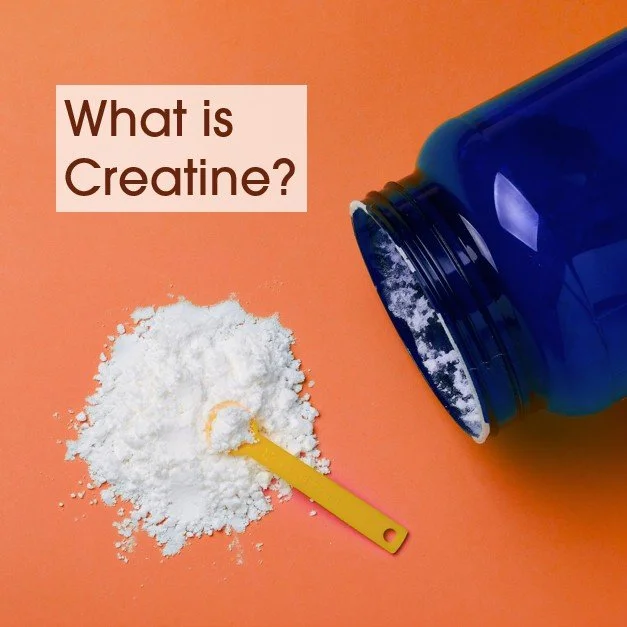
Creatine (C₄H₁₁N₃O₃.) is compound made from three amino acids. We typically get 50% of our creatine from our food – mostly meat and fish and our bodies synthesize the remaining 50%. The supplement form is creatine monohydrate, and vegan formulations are available.
Most creatine goes to your skeletal muscles, which convert creatine into a compound of creatine and phosphoric acid (phosphocreatine or creatine phosphate).
What does creatine do in our bodies?
Creatine acts and an energy buffer and energy shuttle.
You may have learnt at school that respiration in our cells converts the energy from our food into high energy bonds in the three phosphate bearing compound Adenosine Triphosphate (ATP), which is made by adding an additional phosphate group to Adenosine Diphosphate (ADP). This can then be broken down again to ADP to release energy to power all sorts of processes in the body including contraction of your muscle fibres.
The breakdown of creatine phosphate provides a readily accessible buffer of free energy and phosphate that can be used to top up Adenosine Triphosphate (ATP). It also acts as an energy shuttle, since the creatine phosphate can easily diffuse across the membrane into the muscle fibre cytoplasm where is can be used to quickly regenerate ATP for muscle contraction. Thus, creatine helps maintain a continuous energy supply to your muscles during intense weight lifting or exercise.
What are the benefits of creatine for your muscles?
Creatine gives your muscles the energy to work harder and for longer, thus helping you build stronger and bigger muscles.
It also appears to help speed up muscle recovery by activating satellite cells in muscles, which help the micro-tears caused by exercise to heal and get stronger.
It can also influence hormones that contribute to muscle growth.
Finally, it appears that creatine boosts the water content of muscle cells reducing dehydration and cramping.
These effects have been studied for decades in young athletes across many sports from ice skating to swimming, and there is strong to evidence to support the benefits of creatine for building muscle and athletic performance, at least when combined with training.
The International Society of Sports Nutrition put out a position statement on the safety and efficacy of creatine supplementation in exercise and sport in 2017. After assessing the data from thousands of studies, they came to the conclusion that creatine monohydrate is safe (at low doses) and is the most effective nutritional supplement currently available to athletes with the intent of increasing high-intensity exercise capacity and lean body mass during training.
The effects are fairly modest – this isn’t something that sporting bodies worry about banning, but they have been repeatedly demonstrated in studies of young, mostly male athletes. The benefits of creatine supplementation appear to be less pronounced in female athletes.

What about older exercisers?
As it’s become widely recognised that building and maintaining muscle is vital for healthy ageing many of us have taken up weight training and upped our protein intake in our middle and older years. Creatine supplementation has also exploded in the general population.
Maintaining muscle mass is important to retain strength and mobility as we age and also to keep us metabolically healthy. Is there a role for creatine here in halting muscle loss (sarcopenia)?
Studies of the effects of creatine supplementation in older adults have been smaller and fewer than those in younger age groups. And the results are mixed, indicating improvements in functionality and strength, but not necessarily muscle mass. It also looks like the benefits only occur when combined with resistance training and with long periods of daily supplementation. There are no short cuts!
Other therapeutic effects
The data to back up other health claims are more limited.
Osteoporosis
Another concern as we age is bone health. Cell and animal studies have suggested that creatine may improve bone mineralisation. However, studies in humans have given mixed and somewhat confusing results.
A small, 12 week study in men showed modest increases in bone density in men supplementing with creatine in addition to undertaking resistance training. The authors suggested that the increase in bone mineral content may have be due to an enhanced muscle mass, with potentially greater tension on the bones at sites of muscle attachment.
Another small study (just 47 women) showed similar effects in post-menopausal women undertaking resistance training. Those who supplemented with creatine had better bone health measures after 12 months than those who took a placebo.
However, a larger sized placebo controlled study that followed Spanish post-menopausal women for 2 years found no beneficial effect of creatine supplementation (3g a day) alone on bone health. Nor did it affect lean mass or muscle function in this group. Creatine alone appears not to have bone or muscle building properties in long term studies.
And a metanalysis pulling together the results of multiple studies indicated that creatine supplementation (ranging from ~5–8 g/day) during resistance training programs (3–12 months) was not effective for increasing bone mineral density as measured at the lumbar spine, femoral neck, total hip, or whole body in older males or postmenopausal females. Clearly, longer and larger scale high quality studies are still needed to clarify the effectiveness of creatine supplementation, with and without resistance training, in older groups.
Brain health
Creatine crosses the blood brain barrier and this biological fact has led to speculation about potential neurological and mental health benefits.
Given its role as an energy buffer, researchers have speculated that it may have the greatest effects for brains under stress, e.g. under conditions of sleep deprivation, dementia or depression which may involve a lack of energy.
But again the evidence is typically limited to very small clinical studies. For example, a study that showed that creatine improves cognitive performance and processing speed during sleep deprivation involved just 8 study participants. Not enough to hang your hat on!
A study examining the effect of creatine supplementation on the cognitive performance of elderly people was also very small with 17 participants in the placebo group and 15 participants taking creatine. They did find a significant positive effect on most measures…but again this is too small to be useful.
Mouse models suggested that creatine could play a role in delaying Alzheimer’s progression. A very small pilot study last year in 20 individuals also suggested that creatine may help improve cognitive function in Alzheimers patients. But this was a very small study, and not placebo controlled. Clearly more research is needed.
Studies of depression
The theory behind use of creatine supplementation in depression was that creatine’s activity as an energy buffer and shuttle may help with brain bioenergetics and may act synergistically with other treatments.
Most of the data comes from animal studies and studies without placebo controls.
However, a small proof of concept study (52 women over 8 weeks) did show improvements in the effectiveness of the SSRI (escitalopram) when combined with creatine supplementation to reduce depression symptoms.
And a slightly larger randomised controlled trial with 100 participants also found that creatine supplementation improved the effectiveness of cognitive behavioural therapy compared to CBT and placebo. Again more large-scale studies are needed.
Some wellness influences are taking the results from these small studies and extrapolating from them to extoll the virtues of creatine for improving general cognitive performance. The data just isn’t there to support this yet. Worryingly, given the possible side-effects (see below) they also recommend much higher doses than has typically been used to improve athletic performance.

Minor side-effects of creatine supplementation
Creatine has been widely used for decades without any major signals of safety problems, however it can cause:
Dizziness
Nausea and vomiting
Diarrhoea
Excessive sweating
Weight gain and bloating through water retention (although studies indicate this is short lived)
These can often be countered by reducing the creatine dose or splitting consumption across the day. However, the digestive symptoms are likely to be more concerning if you already have a sensitive gut.
Who should be cautious?
It’s also a good idea to skip creatine if you have a kidney problems. Creatine typically doesn’t appear to affect kidney function in healthy people, but there are case studies suggesting that creatine might worsen kidney dysfunction in people with kidney disorders and even a case of a young previously healthy 18 year old young man experiencing kidney damage after taking the recommended dose.
Further, creatine supplementation is generally not advised during pregnancy or breastfeeding due to insufficient safety research. And similarly it is not recommended in children and adolescents due to unknown long-term effects.
Possible cancer risk?
Possibly of more concern is the research around cancer.
It has been suggested that creatine may contribute to the formation of chemical compounds, such as heterocyclic amines (HCAs), which are associated with an increased risk of cancer. However, if there was a large effect we would expect to have seen a pattern emerge amongst the large number of athletes that have taken creatine. And as yet, none has been documented.
The animal research is mixed. Some animal studies have indicated that it can reduce the growth of implanted cancers. But there is also laboratory data to suggest that it can power the spread of existing cancer. Experiments using mouse models revealed that creatine promoted the invasion and metastasis of pancreatic cancer, colorectal cancer, and breast cancer.
It’s important to note that there is no evidence from human studies that it causes cancer or promotes it’s spread. It is likely safe, but cancer patients may wish to be cautious about taking this supplement.

The all important taste
Creatine tastes bitter and can be gritty. Some manufacturers claim this is a quality, contamination or staleness issue, but all tend to recommend mixing it with fruit juice or coffee to mask the taste.
The recent scandal on lower than advertised levels of creatine in gummies, demonstrates that good tasting creatine supplements really are too good to be true.
Why we decided against adding creatine to our shakes
We’ve spent some time over the last 12 months considering re-formulating our shakes. We decided not to jump on the creatine band wagon for three reasons:
We didn’t want to add something to our shakes that could cause digestive distress or that tastes bitter – we want our shakes to be something you look forward to having daily that you can trust not to trigger symptoms.
The benefits for muscle growth and performance are modest and on balance maintaining intake of high quality protein whilst training is a better proposition considering the possible side effects. The other possible therapeutic benefits of creatine are interesting, but need more supporting data.
The potential kidney and cancer risks worried us. The studies that indicate a cancer risk are all animal studies, not large-scale clinical studies, but we thought it was something that individuals would want to weigh up for themselves.
Blog written by: Noisy Guts co-founder Dr Mary Webberley. Mary has a background in biology, with two degrees from the University of Cambridge and post-doctoral research experience.
References:
Antonio, J., et al. (2021). Common questions and misconceptions about creatine supplementation: what does the scientific evidence really show?. Journal of the International Society of Sports Nutrition, 18(1), 13. https://doi.org/10.1186/s12970-021-00412-w
Kreider, R. B., et al. (2017). International Society of Sports Nutrition position stand: safety and efficacy of creatine supplementation in exercise, sport, and medicine. Journal of the International Society of Sports Nutrition, 14(1). https://doi.org/10.1186/s12970-017-0173-z
S. Forbes, et al. (2018) Creatine supplementation during resistance training does not lead to greater bone mineral density in older humans: a brief meta-analysis, Front. Nutr. 5 https://doi.org/10.3389/ FNUT.2018.00027.
Stares A, Bains M. The Additive Effects of Creatine Supplementation and Exercise Training in an Aging Population: A Systematic Review of Randomized Controlled Trials. (2020) J Geriatr Phys Ther. 43(2):99-112. doi:10.1519/JPT.0000000000000222
Chilibeck PD, et al. (2005) Creatine monohydrate and resistance training increase bone mineral content and density in older men. J. Nutr. Health Aging. 9:352–3.
Chilibeck, P D. et al. (2015) Effects of Creatine and Resistance Training on Bone Health in Postmenopausal Women. Medicine & Science in Sports & Exercise 47(8):p 1587-1595, August 2015. | DOI: 10.1249/MSS.0000000000000571
Sales LP, et al. (2020) Creatine Supplementation (3 g/d) and Bone Health in Older Women: A 2-Year, Randomized, Placebo-Controlled Trial. J Gerontol A Biol Sci Med Sci. 75(5):931-938. doi:10.1093/gerona/glz162
Forbes, S, Chilibeck, P, Candow, D (2018) Creatine supplementation during resistance training does not lead to greater bone mineral density in older humans: a brief meta-analysis, Front. Nutr. 5 (2018), https://doi.org/10.3389/ FNUT.2018.00027.
Candow, D. G., et al. (2022). Creatine supplementation for older adults: Focus on sarcopenia, osteoporosis, frailty and Cachexia. Bone, 162, 116467. https://doi.org/10.1016/j.bone.2022.116467
Gordji-Nejad, A., Matusch, A., Kleedörfer, S. et al. (2024) Single dose creatine improves cognitive performance and induces changes in cerebral high energy phosphates during sleep deprivation. Sci Rep 14, 4937 https://doi.org/10.1038/s41598-024-54249-9
McMorris, T., et al. (2007). Creatine Supplementation and Cognitive Performance in Elderly Individuals. Aging, Neuropsychology, and Cognition, 14(5), 517–528. https://doi.org/10.1080/13825580600788100
Smith AN, et al. (2025) Creatine monohydrate pilot in Alzheimer's: Feasibility, brain creatine, and cognition. Alzheimers Dement (N Y). 11(2):e70101. Published 2025 May 19. doi:10.1002/trc2.70101
Yoon S, et al. (2016)Effects of Creatine Monohydrate Augmentation on Brain Metabolic and Network Outcome Measures in Women With Major Depressive Disorder. Biol Psychiatry. 80(6):439-447. doi:10.1016/j.biopsych.2015.11.027
Sherpa NN, et al (2025) Efficacy and safety profile of oral creatine monohydrate in add-on to cognitive-behavioural therapy in depression: An 8-week pilot, double-blind, randomised, placebo-controlled feasibility and exploratory trial in an under-resourced area. Eur Neuropsychopharmacol. 90:28-35. doi:10.1016/j.euroneuro.2024.10.004
Miller E, Evans A, Cohn M. (1993) Inhibition of rate of tumor growth by creatine and cyclocreatine. Proc Natl Acad Sci U S A. = 90:3304–8. 10.1073/pnas.90.8.3304
Geng Y, DeLay SL, Chen X, Miska J. (2024) It Is Not Just About Storing Energy: The Multifaceted Role of Creatine Metabolism on Cancer Biology and Immunology. Int J Mol Sci. 25(24):13273. doi: 10.3390/ijms252413273. PMID: 39769038; PMCID: PMC11678534.
Longobardi I, et al. (2025) A short review of the most common safety concerns regarding creatine ingestion. Front Nutr. 2025 Dec 1;12:1682746. doi: 10.3389/fnut.2025.1682746. PMID: 41404326; PMCID: PMC12702719. https://pmc.ncbi.nl)m.nih.gov/articles/PMC12702719/
Zhang L, Bu P. (2022) The two sides of creatine in cancer. Trends Cell Biol. 32(5):380-390. doi:10.1016/j.tcb.2021.11.004